Other Stuff, Part 1: Cushing’s

Based on one of the comments for my first post (The Beginning), I’m going to mention some of our past medical misadventures here, too.

This one was mine, and it was a doozy!
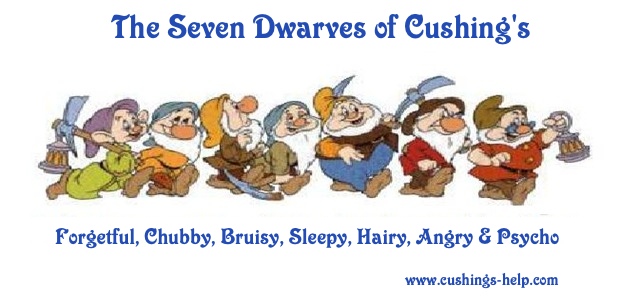
Seven Dwarves of Cushing's

From a recent post on one of my blogs: A Quarter of a Century

I had my one, and only, pituitary surgery on this date in 1987.  Of course, I was trying to get a diagnosis for several years before that.

I know it’s hard to get a diagnosis now – imagine how hard it was over 30 years ago – before the Internet, Facebook, Twitter, message boards, chatrooms.  No online support – no support anywhere.

Finding any information possible at the Public Library.  Days that you feel like death warmed over, heading out to the library to Xerox medical articles you don’t understand, poring over them at home, trying to find any kernel of hope for what you have.  Then trying to convince doctors when your family doesn’t even believe you.

Finally, a doctor believes you…but he’s the wrong kind of doctor so he sends you away.  Another year goes by.  The endo recommends surgery but there are only 3 possibilities anywhere.  NIH – close by and free, Montreal – they speak French – and San Francisco.

After a diagnosis, 6 weeks of inpatient testing at the NIH.

From my bio at http://www.cushings-help.com/maryos_story.htm

There were about 12 of us there and it was nice not to be alone with this mystery disease. Many of these Cushies (mostly women) were getting bald, couldn’t walk, having strokes, had diabetes. One was blind, one had a heart attack while I was there. Towards the end of my testing period, I was looking forward to the surgery just to get this whole mess over with. While I was at NIH, I was gaining about a pound a day!

The MRI still showed nothing, so they did a Petrosal Sinus Sampling Test. That scared me more than the prospect of surgery. (This test carries the risk of stroke and uncontrollable bleeding from the incision points.) Catheters were fed from my groin area to my pituitary gland and dye was injected. I could watch the whole procedure on monitors. I could not move during this test or for several hours afterwards to prevent uncontrolable bleeding from a major artery. The test did show where the tumor probably was located. Also done were more sophisticated dexamethasone suppression tests where drugs were administered by IV and blood was drawn every hour (they put a heplock in my arm so they don’t have to keep sticking me). I got to go home for a weekend and then went back for the surgery – the Transsphenoidal Resection. I fully expected to die during surgery (and didn’t care if I did) so I signed my will and wrote last letters to those I wanted to say goodbye to. During the time I was home just before surgery, a college classmate of mine (I didn’t know her) did die at NIH of a Cushing’s-related problem. I’m so glad I didn’t find out until a couple months later!

November 3, 1987, the surgeon, Dr. Ed Oldfield, cut the gum above my front teeth under my upper lip so there is no scar. He used tiny tools and microscopes. My tumor was removed successfully. In some cases (not mine) the surgeon uses a plug of fat from the abdomen to help seal the cut. Afterwards, I was in intensive care overnight and went to a neurology ward for a few days until I could walk without being dizzy. I had some major headaches for a day or two but they gave me drugs (morphine) for those. Also, I had cotton plugs in my nostrils. It was a big day when they came out. I had diabetes insipidus (DI) for a little while, but that went away by itself – thank goodness!

I had to use a foam product called “Toothies” to brush my teeth without hitting the incision. Before they let me go home, I had to learn to give myself an injection in my thigh. They sent me home with a supply of injectible cortisone in case my level ever fell too low (it didn’t). I was weaned gradually off cortisone pills (scary). I now take no medications. I had to get a Medic Alert bracelet. I will always need to tell medical staff when I have any kind of procedure – the effects of my excess cortisone will remain forever.

I went back to the NIH for several follow-up visits of a week each where they did all the blood and urine testing again. After a few years NIH set me free. Now I go to my “outside” endocrinologist every year for the dexamethasone suppression test, 24-hour urine and regular blood testing.

As I get further away from my surgery, I have less and less chance that my tumor will grow back. I have never lost all the weight I gained and I still have the hair on my chin but most of my other symptoms are gone. I am still and always tired and need a nap most days. I do not, however, still need to take whole days off just to sleep.

I consider myself very lucky that I was treated before I got as bad as some of the others on my floor at NIH but think it is crazy that these symptoms are not taken seriously by doctors.


My whole, long journey with diagnosing and treating Cushings can be found in my bio at https://cushingsbios.com/2025/10/28/maryo-pituitary-bio/

Other Cushing’s sites.

National Clean Out Your Medicine Cabinet Day

This is a holiday I can really get behind!

Gear up for National Clean Out Your Medicine Cabinet Day! Happening every third Friday in April, this crucial day is all about purging your home of unused or expired medications that could pose serious risks.

Why should you care? Leftover medications can tempt family members, friends, or visitors, potentially leading to misuse or abuse. Plus, improper disposal can wreak havoc on our environment, contaminating the water we drink and the soil that nourishes our food.

How to Make a Difference:

1. **Survey and Sort:** Dive into every nook where medications might hide — from medicine cabinets to kitchen drawers. Don’t forget to check your pet’s meds too!

2. **Eco-Friendly Disposal:** Say no to flushing meds! Opt for at-home drug disposal solutions like DisposeRx to keep our waters clean.

3. **DEA National Drug Takeback Day:** Got a stash to clear out? Join in on DEA’s Takeback Day, held twice a year for those larger hauls.

Share Your Success: After you’ve cleared out your meds, snap a photo and share it on social using the hashtag #CleanOutMedsDay. Let’s spread the word and encourage others to join the movement!

DisposeRx initiated National Clean Out Your Medicine Cabinet Day in 2019 to spotlight the dangers of hoarding old meds. With risks ranging from drug addiction to accidental poisoning, it’s more important than ever to keep our homes safe and our environments clean.

Mark your calendars! This day is officially recognized on the third Friday in April each year. And remember, when it comes to medicine, storage matters. Keep your meds in cool, dry, dark places to preserve their potency.

Did you know? Medications can lose or even increase their potency over time, depending on how they’re stored. Make sure your meds are safe and effective by keeping them in optimal conditions.

Join in making homes safer and the planet healthier on National Clean Out Your Medicine Cabinet Day!


Patient Outcomes Significantly Improved By L-Carnitine Following Heart Attack

myocardial infarction - Myokardinfarkt - scheme

myocardial infarction – scheme (Photo credit: Wikipedia)

L-carnitine significantly improves cardiac health in patients after a heart attack, say a multicenter team of investigators in a study published in Mayo Clinic Proceedings. Their findings, based on analysis of key controlled trials, associate L-carnitine with significant reduction in death from all causes and a highly significant reduction in ventricular arrhythmias and anginal attacks following a heart attack, compared with placebo or control.

Heart disease is the leading cause of death in the United States. Although many of the therapies developed in recent decades have markedly improved life expectancy, adverse cardiovascular events such as ventricular arrhythmias and angina attacks still occur frequently after an acute myocardial infarction (heart attack).

It is known that during ischemic events L-carnitine levels are depleted. Investigators sought to determine the effects of targeting cardiac metabolic pathways using L-carnitine to improve free fatty acid levels and glucose oxidation in these patients. By performing a systematic review and meta-analysis of the available studies published over several decades, they looked at the role of L-carnitine compared with placebo or control in patients experiencing an acute myocardial infarction.

L-carnitine is a trimethylamine which occurs in high amounts in red meat and is found in certain other foods, and is also widely available as an over-the-counter nutritional supplement which is claimed to improve energy, weight loss, and athletic performance. Its potential role in treating heart disease was first reported in the late 1970s.

A comprehensive literature search yielded 153 studies, 13, published from 1989-2007, were deemed eligible. All the trials were comparison trials of L-carnitine compared with placebo or control in the setting of acute myocardial infarction.

This systematic review of the 13 controlled trials in 3,629 patients, involving 250 deaths, 220 cases of new heart failure, and 38 recurrent heart attacks, found that L-carnitine was associated with:

  • Significant 27% reduction in all-cause mortality (number needed to treat 38)
  • Highly significant 65% reduction in ventricular arrhythmias (number needed to treat 4)
  • Significant 40% reduction in the development of angina (number needed to treat 3)
  • Reduction in infarct size

There were numerically fewer myocardial reinfarctions and heart failure cases associated with L-carnitine, but this did not reach statistical significance.

First author James J. DiNicolantonio, PharmD, Wegmans Pharmacy, Ithaca, NY, observes, “Although therapies for acute coronary syndrome (ACS), including percutaneous coronary intervention, dual antiplatelet therapy, b-blockers (BBs), statins, angiotensin-converting enzyme inhibitors (ACEIs), omega-3 fatty acids, and cardiac rehabilitation, have markedly improved clinical outcomes, adverse cardiovascular (CV) events still occur too frequently after ACS. One promising therapy for improving cardiac health involves using L-carnitine to improve free fatty acid levels and glucose oxidation.”

“The potential mechanisms responsible for the observed beneficial impact of L-carnitine in acute myocardial infarction are likely multifactorial and may, in part, be conferred through the ability of L-carnitine to improve mitochondrial energy metabolism in the heart by facilitating the transport of long-chain fatty acids from the cytosol to the mitochondrial matrix, where b-oxidation occurs, removing toxic fatty acid intermediates, reducing ischemia induced by long-chain fatty acid concentrations, and replenishing depleted carnitine concentrations seen in ischemic, infarcted, and failing myocardium,” says DiNicolantonio.

L-carnitine is proven to be safe and is readily available over the counter. The investigators agree that the overall results of this meta-analysis support the potential use of L-carnitine in acute myocardial infarction and possibly in secondary coronary prevention and treatment, including angina. They advocate for a larger randomized, multicenter trial to be performed to confirm these results in the modern era of routine revascularization and other intensive medical therapies following acute myocardial infarction. But, says DiNicolantonio, “L-carnitine therapy can already be considered in selected patients with high-risk or persistent angina after acute myocardial infarction who cannot tolerate treatment with ACE inhibitors or beta blockers, considering its low cost and excellent safety profile.”

These findings may seem to contradict those reported in a study published earlier this month in Nature Medicine by Robert A. Koeth and others (Koeth, R. A. et al. Nature Med.*), which demonstrated that metabolism by intestinal microbiota of dietary L-carnitine produced trimethylamine N-oxide (TMAO) and accelerated atherosclerosis in mice. They also noted that omnivorous human subjects produced more TMAO than did vegans or vegetarians following ingestion of L-carnitine, and suggested a possible direct link between L-carnitine, gut bacteria, TMAO, and atherosclerosis and risk of ischemic heart disease.

“The Nature Medicine paper is of interest,” agrees senior investigator Carl J. Lavie, M.D.,FACC,FACP,FCCP, Medical Director of the Cardiac Rehabilitation and Prevention Center at the John Ochsner Heart and Vascular Institute at the University of Queensland School of Medicine in New Orleans, “but the main study reported there was in animals, and unlike our study, lacks hard outcomes.” He also notes that “there are various forms of ‘carnitine’ and our relatively large meta-analysis specifically tested L-carnitine on hard outcomes in humans who had already experienced acute myocardial infarction.”

from Sciences, E. (2013, April 16). “Patient Outcomes Significantly Improved By L-Carnitine Following Heart Attack.” Medical News Today. Retrieved from
http://www.medicalnewstoday.com/releases/259096.php.

Wednesday, Nine Weeks Post-Op

day-late

Running Late!  The Nine Week Anniversary was 2 days ago.  I got so tired singing  Holy Thursday, Good Friday and three Easter Services that I’ve just been resting up for a few days.

It also turned out that our son came home Thursday night, after rehab, after that service so my energy has been really sapped.

DH is still doing well, the rehab continues and he’s done 5 as of today.  We also signed up for our first patient meeting next Tuesday and a class on Cardiac Valve Surgery later this month.

So…we have rehab Wednesday and Thursday this week, Mended Hearts on Saturday, Monday rehab, Tuesday patient meeting, Wednesday and Thursday rehab…

Soon we’ll be experts!

Because DS was here, we ate some foods that I doubt are on the new diet.  I hope that there are no setbacks because of this.

Yesterday was one of those busy days.  A friend happened to call on Monday while we were driving back from rehab and DH took the call since I was driving.  As a result, DH, DS, my mom and I all went out with the friend in the afternoon.  In the morning, I had a staff meeting for work.  Our son decided that it was closer for him to take the train back to NYC from our friend’s, so we swung by the train station on the way home.

A tiring, but fun, day.  Our friend also has stairs up to her house, so it was one of the first times DH climbed a lot of them.

In church on Sunday, someone prayed for another who had had surgery before DH’s and wasn’t doing well yet.  It makes me very thankful for how well things are working out here.


The Mixed Blessing of Heart Surgery

Three coronary artery bypass grafts, a LIMA to...

Three coronary artery bypass grafts, a LIMA to LAD and two saphenous vein grafts – one to the right coronary artery (RCA) system and one to the obtuse marginal (OM) system. (Photo credit: Wikipedia)

Angioplasty and heart bypass surgery are giants among medical procedures in America. They are performed more than a million times each year and together drive a $100-billion industry. But an article in the recent issue of Harvard Magazine explores a frightening truth: There’s no evidence that they improve life expectancy by even a single day. – See more at:

The mixed blessing of heart surgery.

Coronary Artery Bypass Graft (CABG off-pump)

heart with coronary arteries

heart with coronary arteries (Photo credit: Wikipedia)

Before we talk about treatment, let’s start with a discussion about the human body and about your medical condition.

Your doctor has recommended that you have coronary artery bypass surgery. But what does that actually mean?

  • Your heart is located in the center of your chest.
  • It is surrounded by your rib cage and protected by your breastbone.
  • Your heart’s job is to keep blood continually circulating throughout your body.
  • The vessels that supply the body with oxygen-rich blood are called arteries.
  • The vessels that return blood to the heart are called veins.
  • Like any other muscle in the body, the heart depends on a steady supply of oxygen rich blood. The arteries that carry this blood supply to the heart muscle are called coronary arteries.
  • Sometimes, these blood vessels can narrow or become blocked by deposits of fat, cholesterol and other substances collectively known as plaque.
  • Over time, plaque deposits can narrow the vessels so much that normal blood flow is restricted. In some cases, the coronary artery becomes so narrow that the heart muscle itself is in danger.
  • Coronary bypass surgery attempts to correct this serious problem. In order to restore normal blood flow, the surgeon removes a portion of a blood vessel from the patient’s leg or chest, most probably the left internal mammary artery and the saphenous vein.
  • Your doctor uses one or both of these vessels to bypass the old, diseased coronary artery and to build a new pathway for blood to reach the heart muscle.
  • These transplanted vessels are called grafts and depending on your condition, your doctor may need to perform more than one coronary artery bypass graft.

Other Stuff, Part 4: Fire Ants

WayBack Machine


This one is from the WayBack machine.

I’m trying to work out the year – we bought our first time share while I was being diagnosed with Cushing’s so this was some time after 1987.  We never stayed in that time share, just used it for trade.  This particular year, we’d traded for a place in Arkansas (not too exciting, but drivable from home) but they had a fire so they offered us a 3-bedroom house in Hilton Head instead.  Of course, we accepted that offer!

We located a kennel fairly nearby to leave our dog.  We were so sure she’d love the ocean just like the dogs on TV do, running and playing in the water. She was a retriever so she could swim out and fetch frisbees and such.  HA!

We packed up the dog and our stuff and made the long drive down to South Carolina.  We dropped her off at the kennel and found our home for the next week.  Absolutely beautiful, on a little lagoon, in the middle of a golf course community. Our son had the upstairs all to himself and he loved that.

Our lagoon had an alligator and one day the young boy next door was out on the porch.  We could see the alligator eyes watching him…and waiting.  Luckily, nothing happened!

We took the dog out of the kennel and onto the beach and all those years of instincts failed her.  When a wave came in, she tried to bite it – and swallowed.  She was – ahem – sick as a dog for the rest of the trip.  So much for running and playing in the waves.

When our son got out of the water, we realized that he had some sting marks on his leg.  Most likely from a jelly fish someone said.  Great!

Our house had come with bikes and we used them to ride all over the golf course and out into Hilton Head sometimes.  This evening, we were riding along the street and there was a red light.  We stopped and I put my foot down on the pavement.  Naturally, I was wearing sandals.  Naturally, I’d stepped into a fire ant nest.

The rest of the trip was awful. Burning, itching, pain.  The ant bites seemed like they were increasing in number, not getting better.

It was the end of the week, so we headed home.  I was in misery all the way.

First off, I saw my PCP who prescribed something for me.  I think it might have been an antibiotic but I can’t remember.  I woke up that night, red, itchy, broken out in hives.

About 3AM, DH took me to the ER – I was having an allergic reaction to the meds.  Great!  They pumped me full of epinephrine and I started to get better.

The next morning I was back at the PCP for another drug.  I took that for one dose and had the worst nightmares of my life.  I went back to the PCP the next day and he said that no one had reported nightmares from that drug and I told him to alert whoever – one person had had them.

And I got another drug.  This one finally worked and the ant bites and the infection that they’d caused finally started going away.

Will I ever go back to Hilton Head?  I don’t know.  I do know I won’t ride a bicycle wearing sandals at dusk.  That’s for sure!

Heart Attacks and Depression

Studies show that 48 percent of people can develop depression following a heart attack. But experts say this depression may not be purely psychological. After a cardiac event, the heart may be unable to pump blood as efficiently—causing patients to lose energy.

In addition, chemicals are released in the brain that can work to physiologically cause mood changes. Interestingly, the same study showed that women who suffer heart attacks are 20 percent more likely to develop depression.

The good news: most of these cases can be treated with anti-depressant drugs.

Twitter Chat on Heart Health February 28 at 1:PM Eastern

Image representing Twitter as depicted in Crun...

Image via CrunchBase

Don’t forget to join the Twitter Chat on heart health tomorrow, February 28 from 1 p.m. – 2 p.m. ET.

This hour-long chat which will feature two leading interventional cardiologists, Dr. John P. Reilly, from Ochsner Medical Center, and Dr. Herbert D. Aronow, from St. Joseph Mercy Hospital.

They will be sharing their expertise and life-saving tips on heart disease prevention, risks, recognizing the symptoms, treatment options, as well as women and heart health.

Mended Hearts is joining the Society for Cardiovascular Angiography and Interventions (SCAI) and USA Today health reporter Liz Szabo in hosting this Twitter Chat.

If you have a question or want to share your heart story then join this hour-long chat.

You can participate or follow along by using the hashtag #heartchat.

Coronary Bypass Surgery

From MedStar Union Memorial Hospital.  They say “Last year alone, our doctors performed more than 880 open-heart surgeries and 6,100 catheter-based procedures, including nearly 2,000 angioplasties. No hospital in Maryland or nationally performs a higher percentage (94 percent) of beating-heart bypass surgeries.”

Warning – graphic video!