Rally for Medical Research Hill Day

Held every September, this Capitol Hill Day event continues the momentum established in 2013, and includes nearly 300 national organizations coming together in support of the Rally for Medical Research.

The purpose of the Rally is to call on our nation’s policymakers to make funding for National Institutes of Health (NIH) a national priority and raise awareness about the importance of continued investment in medical research that leads to MORE PROGRESS, MORE HOPE and MORE LIVES SAVED.

The next Rally for Medical Research Hill Day is Sept. 22, 2016.

Sign up to receive updates, including a link to register once it becomes available.

Hmmm – I Drink Coffee All Day

coffee-maker

This article says differently:

You’re probably drinking coffee at the wrong time of day

Wake up and smell the coffee beans. Many of us start the day in this manner, but sometimes that caffeine kick we’re after doesn’t actually kick. Turns out there’s a good reason – if you’re missing out on an energy boost from that morning cup, science has the answer.

The daily coffee habit isn’t just a delicious ritual, it’s also a vehicle for the planet’s most popular psychoactive drug, caffeine. People the world over rely on this central nervous system stimulant for its ability to keep them alert, despite the myriad side effects including possible anxiety and heartburn (everything in moderation, people).

However, as anyone who’s not a coffee addict will attest, humans are perfectly capable of staying awake without chemical help. This is thanks to our own internal chemistry, and, more specifically, a hormone called cortisol.

As with any hormone, cortisol has several influences on the body, and is most commonly associated with metabolism. Produced in the adrenal cortex above the kidneys, it also plays a role in our stress and alertness levels.

And this is where it gets really interesting. Research has found that cortisol has a natural peak-and-fall cycle in the human body, with the highest levels occurring on average between 8 to 9 am.

Cortisol – and therefore your natural, unaided alertness levels – are important to consider in relation to your caffeine intake. Right when you wake up, your cortisol is already on the climb, which means that the morning coffee shot is going to have a lesser effect.

“If we are drinking caffeine at a time when your cortisol concentration in the blood is at its peak, you probably should not be drinking it,” writes neuroscientist Steven L. Miller. “One of the key principles of pharmacology is use a drug when it is needed [..] Otherwise, we can develop tolerance to a drug administered at the same dose.”

So drinking coffee first thing in the morning makes you more resistant to its effects. Of course, if you’re just drinking it for the taste, go nuts.

But when should you enjoy your coffee, then?

To optimise your coffee break, it’s best to have it between 9.30 and 11.30am. Because cortisol levels peak and rise a couple times during the day, your next window of alertness is between noon and 1pm, and then again between 5.30 and 6.30pm.

Drink coffee in-between these times to reap maximum caffeine benefits, but don’t leave it too late in the day if you want to get a good night’s sleep.



Am I likely to change my habits?  Probably not.  My cortisol levels have been screwed up for over 30 years anyway!


coffee-machine

World Cancer Day 2016

Other Stuff, Part 2: Kidney Cancer

Until I saw it on Facebook, I didn’t know that today was World Cancer Day.  Over the years, our family has dealt with several types of cancer and I have friends that have had cancers of their own.  I think that most every family has been touched by cancer in some way.

In my family:

Colon cancer

  • My dad had it twice and died after his second surgery
  • My aunt had it twice and died after her second surgery.  She was lucky – she never had any symptoms except looking like she was pregnant.
  • My mom had it twice and she’s still alive at 93.  Hooray!  It can be beat with the right attitude.

Kidney Cancer

According to my “risk factors”, I “should” have had colon cancer because both parents and an aunt had it twice each.  Of course, there’s no guarantee that I won’t get that, too.

And the risk factors for kidney cancer aka renal cell carcinoma?  The majority of kidney cancers are renal cell carcinomas.

Risk factors for renal cell carcinoma include:

  • Age. Your risk of renal cell carcinoma increases as you age. Renal cell carcinoma occurs most commonly in people 60 and older.

I was younger than this.

  • Sex. Men are more likely to develop renal cell carcinoma than women are.

I am female

  • Smoking. Smokers have a greater risk of renal cell carcinoma than nonsmokers do. The risk increases the longer you smoke and decreases after you quit.

Not me!

  • Obesity. People who are obese have a higher risk of renal cell carcinoma than do people who are considered average weight.

A Cushing’s gift

  • High blood pressure (hypertension). High blood pressure increases your risk of renal cell carcinoma, but it isn’t clear why. Some research in animals has linked high blood pressure medications to an increased risk of kidney cancer, but studies in people have had conflicting results.

Never had this until the kidney cancer.  It went away immediately post-op.

  • Chemicals in your workplace. Workers who are exposed to certain chemicals on the job may have a higher risk of renal cell carcinoma. People who work with chemicals such as asbestos, cadmium and trichloroethylene may have an increased risk of kidney cancer.

What?  Me work?.

  • Treatment for kidney failure. People who receive long-term dialysis to treat chronic kidney failure have a greater risk of developing kidney cancer. People who have a kidney transplant and receive immunosuppressant drugs also are more likely to develop kidney cancer.

Nope.  Some sites also list polycystic  kidney disease.  I don’t have that but half my husband’s family does.  Hmmm – wonder if that’s contagious

  • Von Hippel-Lindau disease. People with this inherited disorder are likely to develop several kinds of tumors, including, in some cases, renal cell carcinoma.

I’ve wondered about this but, you know, it’s too “rare”.

  • Hereditary papillary renal cell carcinoma. Having this inherited condition makes it more likely you’ll develop one or more renal cell carcinomas.

Not that I know of. 

Pretty close to zero on the risk factors. No signs, no symptoms. I was diagnosed in the ER of my local hospital in 2006.

Skin Cancer

  • My husband has had a variety of melanomas and other skin cancers removed

Breast Cancer

  • Sister-in-Law

Among my friends, there have been many cancers – breast cancers, lung cancers (including people who have never smoked), multiple myelomas,  neuroendocrine cancers (this one is supposed to be really rare.  I have 3 friends with this.), probably some I don’t know about yet – and maybe it is unknown to the person.

Some ideas how to protect yourself and others from cancer.  It could save your life!

Biopsy 2 of 4

I mentioned in an earlier post that I was having some biopsies done.  It had been planned for 3 of them today  2 on my right leg, 1 on my left.

Up at 6:30 to put Lidocaine/Prilocaine cream on the places, covered with waterproof bandages.

I arrived at my doctor’s at 8:30 and found that my insurance would only allow one biopsy at a time. <sigh>


leg1

The doctor removed most (or all?) of the largest one. There are 3 internal stitches and 7 on the outside.  When those 7 are removed in a couple weeks, the doctor will remove the second one, on the other leg.  Then, when the stitches come out for that, she’ll remove the 3rd.

My summer at the doctor’s.  LOL

Meanwhile, we were hoping the pathology report would come back today for the forehead one I did last week but it hasn’t yet.  No news is good news!


Patient Instructions for Biopsy Site Care from Johns Hopkins

  1. Leave your wound dressings in place for the rest of the day of the biopsy and keep them dry.
  2. Change band-aids daily starting the day after the biopsy.
  3. Showers are fine starting the day after the biopsy. Leave the band-aids in place while you shower and change them after you dry off.
  4. During the time period of daily band-aid changes, do not soak in a bath or swim.
  5. The average time for daily band-aid changes is 5 to 6 days (range is from 1 or 2 days up to 2 weeks).
  6. If you need to use anything to clean the wounds, hydrogen peroxide is recommended. If the wounds are fine (i.e., no signs of infection), all that is required is a daily band-aid change.
  7. The wounds may or may not form a scab as they heal; either way is fine.
  8. Continue to change the band-aids daily until there are no open wounds.
  9. The local anesthetic used for the biopsy will usually last for 1 to 2 hours after the procedure. After it wears off, you may have some mild, localized soreness and tenderness at the biopsy sites over the next day or two. You may find regular Tylenol is helpful for the discomfort.
  10. Refrain from doing extremely strenuous activity for the rest of the day of your biopsy (such as running or heavy lifting).
  11. Once you are without the band-aid, the biopsy sites may look slightly red or darker than the rest of your skin. This discoloration will gradually fade and blend back with your normal skin color. This fading process may take anywhere from a few months up to a year.
  12. It is very rare for people to have any problems during the healing period. It is normal for the biopsy sites to bleed a little bit or drain pink fluid for a day or two after the biopsies. They should not bleed excessively (i.e., through the band-aid) after that time. They should never drain pus. If you do experience problems with significant bleeding, redness, infection, or other problems, call your doctor’s office.

Skin Cancer

biopsy


We have a new melanoma in the family, so I’ll be posting a bit about that for a while.

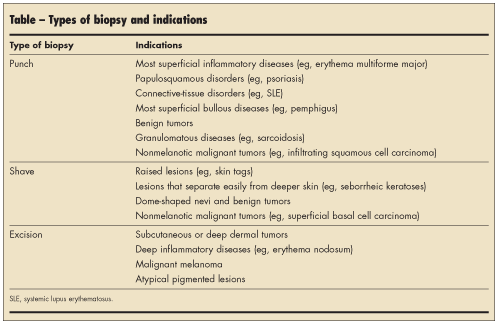
I just had a shave biopsy above my eyebrow last Tuesday and I’ll have 3 punch biopsies on my legs next Tuesday.  Results to follow!

For the non-squeamish:

NINDS Know Stroke Campaign – Know Stroke Home

http://youtu.be/wH7k5CFp4hI

Each year in the United States, there are more than 795,000 strokes. Stroke is the fourth leading cause of death in the country and causes more serious long-term disabilities than any other disease. Nearly three-quarters of all strokes occur in people over the age of 65 and the risk of having a stroke more than doubles each decade after the age of 55.

The National Institutes of Health through the National Institute of Neurological Disorders and Stroke (NINDS) developed the Know Stroke. Know the Signs. Act in Time. campaign to help educate the public about the symptoms of stroke and the importance of getting to the hospital quickly.

Read the entire article at NINDS Know Stroke Campaign – Know Stroke Home.

It’s Fruit and Veggie Season Again :)

hippocratesfoodquote


Federal health officials estimate that nearly 48 million people are sickened by food contaminated with harmful germs each year, and some of the causes might surprise you.

Although most people know animal products must be handled carefully to prevent illness, many don’t realize that produce can also be the culprit in outbreaks of foodborne illness. In recent years, the United States has had several large outbreaks of illness caused by contaminated fruits and vegetables—including spinach, tomatoes, and lettuce.

Glenda Lewis, an expert on foodborne illness with the Food and Drug Administration, says fresh produce can become contaminated in many ways. During the growing phase, fruits and veggies may be contaminated by animals, harmful substances in the soil or water, and poor hygiene among workers. After produce is harvested, it passes through many hands, increasing the contamination risk. Contamination can even occur after the produce has been purchased, during food preparation, or through inadequate storage.

FDA says to choose produce that isn’t bruised or damaged, and make sure that pre-cut items—such as bags of lettuce or watermelon slices—are either refrigerated or on ice both in the store and at home. In addition, follow these recommendations:

  • Wash your hands for 20 seconds with warm water and soap before and after preparing fresh produce.
  • Cut away any damaged or bruised areas before preparing or eating.
  • Gently rub produce while holding under plain running water. There’s no need to use soap or a produce wash.
  • Wash produce BEFORE you peel it, so dirt and bacteria aren’t transferred from the knife onto the fruit or vegetable.
  • Use a clean vegetable brush to scrub firm produce, such as melons and cucumbers.
  • Dry produce with a clean cloth or paper towel to further reduce bacteria that may be present.
  • Throw away the outermost leaves of a head of lettuce or cabbage.


Lewis says consumers should store perishable produce in the refrigerator at 40 degrees or below.

This article appears on FDA’s Consumer Updates page, which features the latest on all FDA-regulated products.

Minimally Invasive Multivessel CABG

This is a video showing Coronary Artery Bypass Grafting being done through left 4th intercostal space by a 6-7cm incision.

We are routinely doing Coronary Artery Bypass Grafting, single vessel or multivessel through left 4th or 5th Intercostal Space depending on position of apex of heart and the target arteries on routine chest x-ray and coronary angiogram. We are using skeletonised LIMA and Free Radial Artery to construct a ‘Y’ and then pick all the vessels to be grafted sequentially. Single Lung ventilation using an endobronchial tube is essential.

Team Includes Dr.Kshitij Dubey (Chief Cardiac Surgeon), Dr. Vikas Gupta (Chief Cardiac Anaesthetist), Dr. Krishnpal Singh (Anaesthetist) Mr.M.V.Krishna Mohan (Sr.Clinical Perfusionist), Rajshree Hospital & Research Centre, Indore, Madhya Pradesh.


How Blood Flows Through the Heart

Diagram of the human heart 1. Superior Vena Ca...

Diagram of the human heart 1. Superior Vena Cava 2. Pulmonary Artery 3. Pulmonary Vein 4. Mitral Valve 5. Aortic Valve 6. Left Ventricle 7. Right Ventricle 8. Left Atrium 9. Right Atrium 10. Aorta 11. Pulmonary Valve 12. Tricuspid Valve 13. Inferior Vena Cava (Photo credit: Wikipedia)

From http://www.interactive-biology.com

In this video, I go through the process of how blood flows through the heart. It shows blood entering via the vena cave to the Right atrium, then getting pumped into the right ventricle, to the pulmonary vein to the lungs, to the left atria, left ventricle and then via the aorta to the rest of the body.

Enjoy!

Coronary Artery Bypass Graft (CABG off-pump)

heart with coronary arteries

heart with coronary arteries (Photo credit: Wikipedia)

Before we talk about treatment, let’s start with a discussion about the human body and about your medical condition.

Your doctor has recommended that you have coronary artery bypass surgery. But what does that actually mean?

  • Your heart is located in the center of your chest.
  • It is surrounded by your rib cage and protected by your breastbone.
  • Your heart’s job is to keep blood continually circulating throughout your body.
  • The vessels that supply the body with oxygen-rich blood are called arteries.
  • The vessels that return blood to the heart are called veins.
  • Like any other muscle in the body, the heart depends on a steady supply of oxygen rich blood. The arteries that carry this blood supply to the heart muscle are called coronary arteries.
  • Sometimes, these blood vessels can narrow or become blocked by deposits of fat, cholesterol and other substances collectively known as plaque.
  • Over time, plaque deposits can narrow the vessels so much that normal blood flow is restricted. In some cases, the coronary artery becomes so narrow that the heart muscle itself is in danger.
  • Coronary bypass surgery attempts to correct this serious problem. In order to restore normal blood flow, the surgeon removes a portion of a blood vessel from the patient’s leg or chest, most probably the left internal mammary artery and the saphenous vein.
  • Your doctor uses one or both of these vessels to bypass the old, diseased coronary artery and to build a new pathway for blood to reach the heart muscle.
  • These transplanted vessels are called grafts and depending on your condition, your doctor may need to perform more than one coronary artery bypass graft.