It Was a Day Like All Days. Or, Was It?

This is the followup to yesterdays post Good News for Me! Drinking Coffee in the Morning Reduces the Risk for Death.

Friday, January 2, 2026 started normal enough.  I went to Pender to practice my upcoming piano-organ duet with a friend.  Then, I was going to the local stand-alone emergency room to check out my thumb.

No big deal, right?

The practice went well and I went home to pick up DH to go to Inova-GoHealth Urgent Care – Greenbriar to see about my painful thumb.  This is the same thumb from my May 17 post but a different problem.

Last weekend starting Christmas Day until Sunday, December 28 we had been to NYC to visit our son and his family.  Leaving Sunday evening, we got to Moynihan Station to take the train home.  Because I had a rolling suitcase, we took the ramp to the train hall instead of the stairs.

It’s unclear what happened next but I know DH fell on the ramp and knocked me over as well as a sign.  My hand was still wrapped around the handle of the suitcase and was hurting quite a bit.

Fast forward to yesterday – my thumb was still hurting so we headed off to the Inova-GoHealth.  They do the usual, weight, height, review meds, take blood pressure.  A bit high.  Take it again – higher still.  Tech person calls in doctor.  Higher again.  He says that they can’t help me or my thumb.  I have to go to the real hospital emergency room.  NOW.

So, we drive over to the ER.  I found that my keys set off the metal detector. While I was signing in with my referral papers, they called me back to triage.  BP is higher again (mine was now over 200/90!).  White Coat Syndrome, maybe?


According to google:
“White coat syndrome (or hypertension) is when your blood pressure spikes to high levels in a doctor’s office due to anxiety or stress about the visit, but returns to normal at home, marked by elevated readings (>140/90 mmHg) in the clinic but normal readings (<135/85 mmHg) elsewhere, requiring home monitoring to prevent misdiagnosis and potential long-term risks like heart issues.”

Symptoms

  • No symptoms at home: The primary sign is normal blood pressure outside the clinic.
  • Anxiety/Stress: Feeling nervous, anxious, or stressed during a medical appointment or when a blood pressure cuff is applied.
  • Elevated readings: Blood pressure consistently over 140/90 mmHg in the office, but below 135/85 mmHg at home.

Causes & Risk Factors

  • Anxiety: The stress and fear associated with medical settings, doctors, or past negative experiences.
  • Stressful environment: The clinical setting itself triggers a physiological stress response.
  • Risk factors for hypertension: Being older, overweight, or having certain chronic conditions can increase risk.

Management & Prevention

  • Home Monitoring: Regularly checking blood pressure at home or using 24-hour ambulatory monitoring to get accurate readings.
  • Stress Reduction: Identifying and addressing the sources of anxiety about doctor visits.
  • Lifestyle Changes: Adopting healthy habits like a good diet, exercise, and managing stress.
  • Provider Communication: Talking to your healthcare team to rule out actual hypertension and avoid unnecessary medication.

Why it matters

  • Misdiagnosis: Can lead to unnecessary hypertension treatment.
  • Increased Risk: Even temporary spikes can strain the heart, potentially increasing long-term risks for heart attack, stroke, and heart failure, say Adventist Health and American Heart Association Journals.

So, I was put in a room and all kinds of tests were started, lots of blood taken, EKG leads applied, more blood pressure monitoring.  This went on for a couple hours, just watching numbers fluctuate.

Then – finally – the long-coveted x-ray of my hand!

Some more monitoring,  Various medical staff told us what some of the numbers meant.  A doctor came in.  One of the staff told him that he was concerned/confused about my EKG results.  The doctor came back and told me that he was going to do a consultation with a cardiac doctor about the EKG.

More monitoring.

The doctor finally came back and said that we could go home.  BUT.  I have to call their cardiac doctor ASAP on Monday morning followed by their recommended Orthopedic Surgeon, followed by my PCP.  I saved some time with all this and arranged the PCP through MyChart.

The nurse came back to remove the EKG leads and give me some Losartan and HCTZ  (hydrochlorothiazide) pills.  I couldn’t hold the water to take the pills so I handed it to DH.  Of course, he immediately started drinking my pill water.

Got the water back, clothes back on and finally on our way home.

Total time: 7 hours.


Test results

And that thumb?

An avulsion fracture fragment.  Google says: “An avulsed fracture fragment is a small piece of bone that breaks off from the main bone, pulled away by a strong force exerted by a tendon or ligament, often during sudden movements in sports, leading to pain, swelling, and instability, with treatment ranging from rest and casting for small fragments to surgery if the fragment is large or significantly displaced”.

Everything else normal except “Regarding her elevated blood pressure, patient has some interesting changes in her EKG while she is here including left bundle branch block but then back to sinus rhythm. No cardiac symptoms. Cardiac workup otherwise reassuring including troponin. Normal creatinine in regards to elevated blood pressure. I will discuss with Virginia Heart cardiology but generally with think that discharge on blood pressure medication outpatient follow-up might be reasonable”.

So,

Maybe more after the cardiologist, maybe surgery after the Orthopedic Surgeon, maybe just a weird day for me.

Will the Days of Hitchhiking Return?


Yesterday (May 16, 2025), I had an appointment with a new-to-me hand and wrist doctor for pain I’m having in my right thumb.  As a pianist/organist/bell ringer/balalaika-ist this isn’t a good place to have pain.

I even have a handle on my coffee cup that’s giving me pain so I’ll have to drink left-handed for a while.

Of course, the first thing they did was take x-rays.  The tech put my hand in all kinds of positions I didn’t know were available and asked me to hold them.  I’m sure that  these didn’t help my pain at all.

The x-rays showed:

Arthritis of carpometacarpal (CMC) joint of right thumb, Degenerative arthritis of metacarpophalangeal joint of right thumb, and Degenerative arthritis of interphalangeal joint of right thumb.

Ok, then.

The doctor came in and asked questions, touched, pushed, pulled places on my thumb – “Does this hurt?”  DUH


There were the usual 3 options.  Brace/Voltaren, injection, surgery (Trapeziectomy).

Google AI Says:

This surgical procedure, commonly known as trapeziectomy with ligament reconstruction and tendon interposition (LRTI) or suspensionplasty, is used to treat thumb carpometacarpal (CMC) joint arthritis. It involves removing the trapezium bone, a small bone at the base of the thumb, and then either suspending the thumb’s metacarpal bone (the bone in the thumb) to the second metacarpal bone with a suture or tendon or using a tendon to support the thumb metacarpal base. 

Here’s a more detailed explanation: 

1. The Problem:

  • Thumb CMC joint arthritis causes pain, stiffness, and limited movement in the thumb. 
  • The trapezium bone is a key part of this joint and can become damaged or worn out due to arthritis. 

2. The Procedure:

  • Trapeziectomy:
    The surgeon makes an incision near the thumb’s CMC joint and carefully removes the trapezium bone. 

  • Suspension:
    To prevent the thumb metacarpal bone from collapsing into the space where the trapezium was, the surgeon often uses one of two methods:
    • Suture Suspension: A suture is used to connect the first metacarpal bone to the second metacarpal bone, providing support. 
    • Tendon Interposition: A tendon is used to support the thumb metacarpal base and act as a replacement for the trapezium. 

  • Other Procedures:
    In some cases, other procedures may be performed to further improve stability or function. 

3. Benefits:

Reduced pain and improved thumb function, Increased thumb mobility and flexibility, and Better grip and pinch strength. 

4. Potential Risks:

  • Continued pain, swelling, stiffness, or weakness.
  • Nerve damage and numbness.
  • Scarring.
  • Infection.
  • Bleeding.
  • Allergic reactions. 

trapeziectomy-factsheet

So, yesterday, I opted for everything except surgery…for now.

First up was the dreaded injection.  I’d read on some message boards and found out from some friends that this “could” be painful.  Major DUH.

As usual, the doctor froze the skin with lidocaine (XYLOCAINE), then injected Betamethasone (CELESTONE) into the carpometacarpal (CMC) joint of right thumb.  This was a new steroid for me so…

Celestone Soluspan is a steroid that prevents the release of substances in the body that cause inflammation.

Celestone Soluspan is used to treat many different inflammatory conditions such as allergic reactionsulcerative colitis, arthritis, lupus, multiple sclerosis, inflammation of the joints or tendons, and problems caused by low adrenal gland hormone levels.

Celestone Soluspan may also be used for other purposes not listed in this medication guide.

From drugs.com


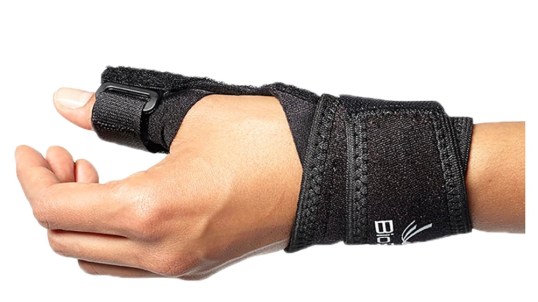
I showed the doctor the brace I had been using.  Years ago with my knee issues, I discovered BioSkin braces for people –

like me who are allergic to neoprene among other things.

Of course, the one I showed him was a reject, being more for carpal tunnel so he “gave” me a thumb spica.  I said “gave” in quotes because they billed me $105.  Presumably, insurance will pay.  I looked it up on the brace company website and found that it would have cost me $45 to buy from them.  Nice markup!

The new spica worked well – I’m to wear that during the day – but I can tell I was starting to itch, so I ordered the BioSkin version from amazon.  That won’t come for a couple weeks, though, so I’ll be itching some.

The doctor also recommended icing for 20 minutes at a time several times a day.  I told him I’d bought a thumb freezer gel pack and he’d never heard of that.  Maybe I’ll take one in next time.

Looking at past posts in this blog, I found that thumb issues have been going on since 2018 but I guess that what the ER did then worked until now!

Hopefully, I get another 8 years out of this visit!


My Days of Hitchhiking are Over

…At least for a while.

Today, I made an appointment with a hand and wrist doctor for pain I’m having in my right thumb.  As a pianist/organist/bell ringer/balalaika-ist this isn’t a good place to have pain.

I even have a handle on my coffee cup that’s giving me pain so I’ll have to drink left-handed for a while.

I do have a good brace for now.  Years ago with my knee issues, I discovered BioSkin braces for people –

like me who are allergic to neoprene among other things.

These are the times of doctors – dentist on Friday, dermatologist on Wednesday. hand/wrist next Friday.  Getting old is the pits!

I know what the first 2 do but have no idea about the H/W doctor.  X-rays?  cortisone shots?  Nothing – we’ll watch it and see what happens? Some dread thing I can’t even imagine?

Looking at past posts in this blog, I found that thumb issues have been going on since 2018 but I guess that what the ER did then worked until now!